
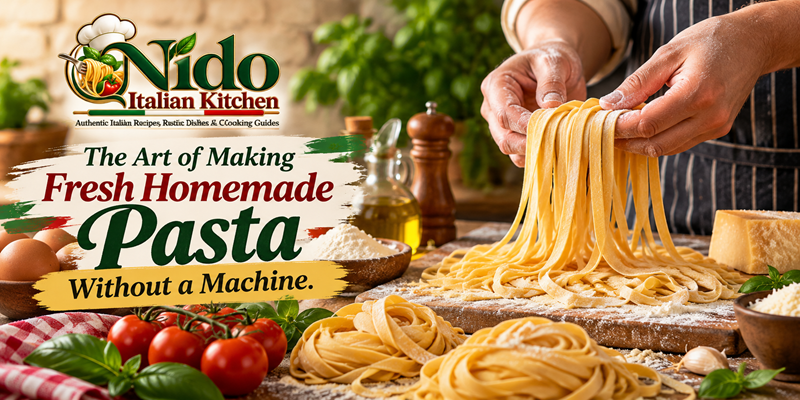
The Art of Making Fresh Homemade Pasta Without a Machine – Handcrafted egg pasta represents one of the most cherished achievements in classic Italian culinary tradition. Long before modern mechanical rollers simplified domestic food preparation, home cooks relied entirely on personal effort, simple boards, and wooden rolling pins. Learning to prepare fresh noodles completely by hand offers an engaging way to experience authentic regional gastronomy.
The Art of Making Fresh Homemade Pasta Without a Machine
Understanding how wheat protein reacts with liquid moisture allows anyone to transform humble kitchen staples into silky, restaurant-quality noodles. This guide outlines the core science, ingredient selection, and physical methods required to craft outstanding pasta from scratch.
Choosing the Ideal Ingredients
Because rustic pasta dough relies on a minimal combination of components, selecting quality ingredients directly impacts the final noodle texture.
1. Flour Selection for Structure
Different wheat flours alter the density, bite, and surface texture of your finished pasta.
-
All-Purpose Flour: A reliable option available in most pantries, offering a balanced protein content suitable for simple hand-rolling.
-
Italian Tipo 00 Flour: Ground into an exceptionally fine powder, this flour creates remarkably smooth dough that yields tender noodles.
-
Semolina Flour: Produced from hard durum wheat, this coarse yellow flour adds structural strength and helps noodles hold sauce effectively.
2. Whole Eggs for Moisture and Richness
Eggs supply essential fats and liquids that bind the dry flour particles together. Using fresh, high-grade eggs improves dough flexibility while giving the pasta a rich golden hue and savory taste. The standard proportion requires approximately one large egg for every 100 grams of flour.
Step-by-Step Preparation Method
Transforming dry flour and raw eggs into flexible sheets requires steady hands and methodical physical technique.
Phase 1: Creating the Center Hollow
Sift your flour directly onto an unpolished wooden board or clean countertop. Gather the powder into a neat mound and use your fingers to carve out a wide central crater, giving it the appearance of a mini volcano. Carefully break your eggs directly into this hollow space.
Phase 2: Mixing the Liquids and Flour
Using a small kitchen fork, gently beat the egg yolks and whites together inside the well. Slowly incorporate tiny portions of flour from the inner wall into the liquid core. As the mixture gradually thickens into a pasty mass, transition to a bench scraper to gather the remaining dry crumbs into a cohesive ball.
Phase 3: Developing Gluten Through Kneading
Kneading builds the elastic protein structure that gives pasta its characteristic chew. Firmly press the heel of your hand into the dough mass, pushing it forward away from your body. Fold the stretched edge back toward the middle, rotate the mass a quarter turn, and repeat the motion. Continue kneading vigorously for roughly eight to ten minutes until the surface becomes smooth and springy.
Phase 4: Allowing the Dough to Rest
Enfold the smooth dough sphere tightly inside a piece of plastic wrap to prevent the surface from drying out. Leave the wrapped package at room temperature for at least thirty minutes. This brief resting period enables the tight gluten strands to relax, making subsequent rolling far less strenuous.
Phase 5: Hand-Rolling the Sheet (La Sfoglia)
Lightly dust your work surface with a pinch of extra flour. Position the rested dough in the center and use a long wooden pin (mattarello) to flatten the disk outward. Apply uniform pressure from the middle toward the outer rim, rotating the circular sheet frequently. Continue rolling until the sheet becomes paper-thin and slightly translucent.
Phase 6: Cutting Classic Noodle Formats
Sprinkle a fine layer of semolina flour across the expanded dough sheet to avoid sticking. Roll the sheet loosely into a flat, wide spiral. Take a sharp chef’s knife and cut across the folded log to produce your chosen pasta width:
-
Pappardelle: Wide ribbons cut approximately 20 millimeters across.
-
Tagliatelle: Standard ribbons cut approximately 6 millimeters across.
-
Fettuccine: Slender ribbons cut approximately 4 millimeters across.
Carefully separate the freshly sliced strands using your fingers, dust them lightly with extra semolina flour, and gather them into loose nests on a dry tray.
Critical Rules for Cooking Fresh Pasta
Because fresh egg pasta contains significant moisture, boiling it demands a slightly different technique than cooking store-bought dried noodles.
| Parameter | Guideline for Fresh Pasta |
| Water Ratio | 4 liters of boiling water per 450 grams of pasta |
| Salting | Generous (water should taste like seawater) |
| Water State | Rapid rolling boil before adding noodles |
| Cooking Time | 2 to 3 minutes maximum |
Kitchen Tip: Always scoop out about half a cup of warm, starchy cooking water just before draining your pasta. Stirring this liquid into your simmering sauce helps bind the sauce seamlessly to the hand-rolled noodles.
Summary
Mastering the process of making fresh homemade pasta without a machine takes patience and a little practice, but the culinary rewards are well worth the effort. By respecting proper dough physics and using quality ingredients, any home cook can craft authentic Italian dishes right from their own kitchen.