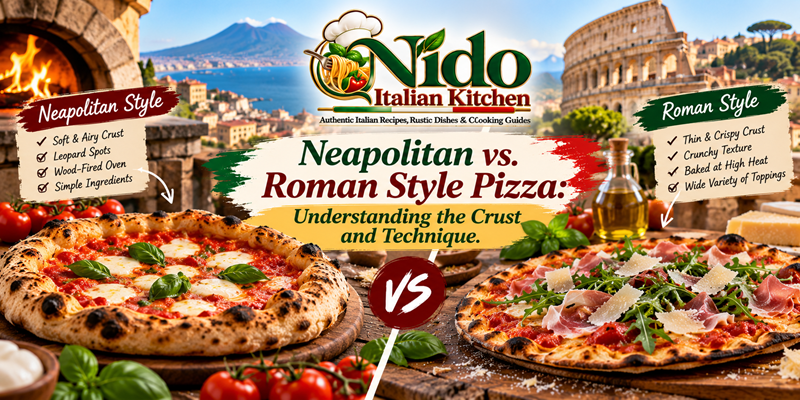
Neapolitan vs. Roman Style Pizza: Understanding the Crust and Technique – Italian pizza tradition is far from uniform across the nation. In fact, different regions take immense pride in their local baking styles, dough formulations, and topping philosophies. Among the most famous regional styles, Neapolitan pizza from Naples and Roman pizza from Rome present contrasting approaches to dough mechanics and oven execution.
Neapolitan vs. Roman Style Pizza: Understanding the Crust and Technique
While both styles rely on high-quality ingredients, their final crust textures offer completely distinct dining experiences. In this educational guide, we will analyze Neapolitan versus Roman style pizza. By examining dough hydration, fermentation, and oven temperatures, you can better understand the craftsmanship behind these iconic Italian styles.
The Soft and Airy Neapolitan Style (Pizza Napoletana)
Neapolitan pizza represents the historic birthplace of modern pizza crafting. Strict guidelines set by traditional culinary associations regulate authentic Neapolitan preparation.
1. Dough Ingredients and Hydration
Authentic Neapolitan dough relies on an ultra-simple recipe: highly refined Tipo 00 flour, water, sea salt, and fresh yeast. The hydration level typically ranges between 60 to 65 percent. Consequently, the dough remains highly pliable and soft, allowing bakeries to stretch it by hand without using a rolling pin.
2. High-Heat Flash Baking
Bakers cook Neapolitan pizza inside a dome-shaped, wood-fired oven heated to roughly 900 degrees Fahrenheit (480 degrees Celsius). The intense heat bakes the pie in just 60 to 90 seconds. As a result, moisture inside the dough expands rapidly, creating a raised, airy outer crust (cornicione) marked with dark blistered spots.
3. Texture and Topping Philosophy
Neapolitan pizza features a soft, tender, and foldable center. Therefore, cooks apply toppings sparingly to prevent the thin middle crust from becoming soggy. Classic preparations include the simple Margherita with San Marzano tomatoes, fresh mozzarella, extra virgin olive oil, and fresh basil leaves.
The Crisp and Thin Roman Style (Pizza Tonda Romana)
While Naples prioritizes soft and pillowy dough, traditional bakeries in Rome favor a thin, sturdy, and exceptionally crispy pie known as Pizza Tonda Romana. Slow-Cooked Pork Sugo: A Rustic Italian Tradition
1. Dough Formula and Oil Addition
Roman dough formulas often incorporate a small percentage of extra virgin olive oil alongside fine flour, water, salt, and yeast. The addition of olive oil tenderizes the dough structure slightly while promoting a distinct crunch during baking. Furthermore, bakers frequently stretch the dough using a rolling pin to achieve a thin, uniform disc.
2. Lower Baking Temperatures and Longer Times
Unlike wood-fired Neapolitan ovens, Roman pizza cooks in electric or gas deck ovens set to lower temperatures around 550 to 650 degrees Fahrenheit (290 to 340 degrees Celsius). The baking process takes roughly three to five minutes. This extended baking time evaporates residual moisture slowly, resulting in a firm crust that holds its shape when sliced.
3. Crisp Structure and Generous Toppings
Because Roman pizza crust stays firm, it supports heavier topping distributions effortlessly. Diners can enjoy a crisp slice from edge to center without experiencing structural collapse.
Key Technical Differences at a Glance
-
Dough Stretch: Neapolitan bakers stretch dough strictly by hand, while Roman cooks often use a rolling pin.
-
Olive Oil: Neapolitan dough excludes oil completely, whereas Roman dough uses oil to enhance crispness.
-
Baking Heat: Neapolitan ovens reach 900 degrees Fahrenheit, while Roman ovens operate around 600 degrees Fahrenheit.
-
Baking Time: Neapolitan pies bake in 90 seconds, whereas Roman pizzas bake for 3 to 5 minutes.
-
Crust Texture: Neapolitan pizza offers a soft, pillowy crust, while Roman pizza delivers a light, crispy crunch.
Structural Comparison of Both Pizza Styles
| Feature | Neapolitan Style | Roman Style (Tonda) |
| Flour Type | Italian Tipo 00 | Tipo 00 or Tipo 1 with olive oil |
| Crust Profile | Soft, airy, and puffy outer rim | Flat, thin, and uniform throughout |
| Baking Method | Wood-fired dome oven | Electric or gas deck oven |
| Eating Style | Folded or eaten with a fork | Cut into sturdy, rigid slices |
Conclusion
Understanding Neapolitan versus Roman style pizza highlights how subtle changes in dough formulas and baking temperatures dramatically alter the final product. Neapolitan pizza celebrates soft, pillowy crusts baked rapidly over intense wood flames. Conversely, Roman pizza emphasizes a crisp, rigid crust produced through patient baking. Both styles honor quality ingredients while offering unique glimpses into regional Italian baking mastery.