
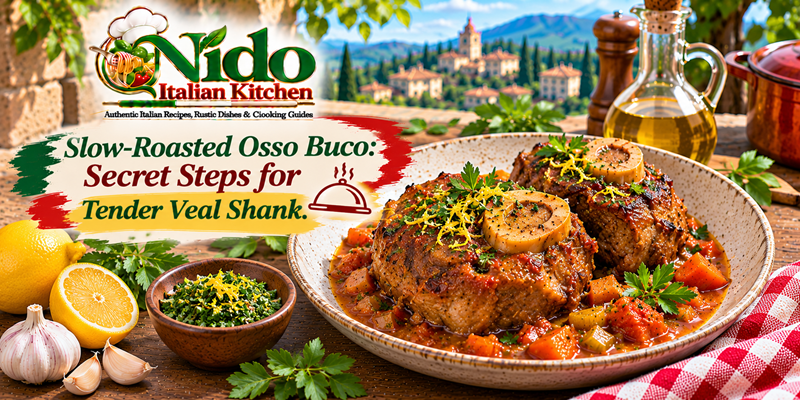
Slow-Roasted Osso Buco: Secret Steps for Tender Veal Shank – In the rich culinary tradition of Northern Italy, Lombardy holds a special place for its hearty braised dishes. Among iconic Milanese classics, slow-roasted Osso Buco (Ossobuco alla Milanese) represents the absolute pinnacle of luxury comfort dining. The name Osso Buco literally translates to “bone with a hole,” referencing the marrow-rich center of the cross-cut veal shank.
Slow-Roasted Osso Buco: Secret Steps for Tender Veal Shank
While veal shanks contain tough connective fibers, slow-roasting transforms the meat into an incredibly tender dish. Furthermore, the rich bone marrow melts into the cooking liquid, creating a velvety sauce. In this educational culinary guide, we will analyze the secret steps for preparing slow-roasted Osso Buco. By understanding meat selection, tying techniques, braising temperature, and gremolata garnishing, you can achieve restaurant-quality results at home.
The Historical Heritage of Milanese Osso Buco
Understanding the cultural roots of Osso Buco explains why specific cooking methods define this classic main course (secondo).
1. Traditional Modern vs. Classic Versions
Historically, early Milanese cooks prepared Osso Buco without tomatoes, using cinnamon, allspice, and broth to braise the meat. Later in the nineteenth century, cooks introduced crushed tomatoes and wine to the recipe. Today, both traditional white (in bianco) and modern red braises remain popular across Italian regions.
2. The Significance of Bone Marrow
The center marrow cavity is not merely a visual accent. During long braising, the rich marrow renders into the braising liquid gradually. Consequently, the marrow provides a buttery richness that no commercial stock can replicate naturally.
Sourcing and Preparing the Essential Ingredients
Achieving exceptionally tender meat relies heavily on selecting high-grade cross-cut veal shanks and fresh aromatics.
1. Cross-Cut Veal Shank Selection
Select cross-cut veal shanks from the hind leg measuring roughly one and a half to two inches thick. Hind leg shanks offer larger meat portions and a more uniform bone shape compared to front leg cuts. Ensure the meat features a light pink color with firm, white marrow in the center.
2. The Traditional Lombard Soffritto
Build your flavor foundation with a finely diced soffritto of yellow onions, carrots, and celery. Sautéing these aromatic vegetables slowly in butter and olive oil creates a sweet, savory base for the braising liquid.
3. Crisp Dry White Wine Selection
Use a dry Italian white wine like Pinot Grigio or Vernaccia to deglaze your pan. The clean acidity of white wine cuts through rich meat fat while lifting caramelized drippings off the pan bottom.
Secret Steps for Unmatched Veal Shank Tenderness
Mastering Osso Buco requires executing precise kitchen techniques before and during the slow-roasting process.
Step 1: Butcher’s Twine Tying
Cross-cut veal shanks surround a central bone encircled by connective membranes. As meat cooks, these outer membranes shrink rapidly, causing the meat to pull away from the bone and warp. To prevent this, tie butcher’s twine tightly around the outer circumference of each shank. Tying keeps the meat attached to the bone throughout the long cooking process.
Step 2: High-Heat Flour Dredging and Searing
Dredge the tied shanks lightly in seasoned flour, shaking off any excess. Sear the shanks in a heavy Dutch oven with olive oil and butter over medium-high heat for four minutes per side. Flour dredging traps internal juices while creating a golden crust that thickens the braising sauce naturally.
Step 3: Deglazing and Liquid Balance
Remove the seared shanks and sauté your diced soffritto in the remaining pan fat until tender. Pour in dry white wine to deglaze, scraping up all browned bits. Next, add hand-crushed tomatoes and rich veal stock. Return the shanks to the pot, ensuring the braising liquid covers two-thirds of the meat height.
Step 4: Low-Temperature Oven Braising
Cover the Dutch oven with a tight lid and transfer it to an oven preheated to 325 degrees Fahrenheit (160 degrees Celsius). Roast the Osso Buco slowly for two to two and a half hours. Low, indirect heat breaks down tough collagen gently, turning the veal shank meltingly tender.
Step 5: Fresh Gremolata Finishing
Just before serving, sprinkle fresh gremolata over the hot meat. Gremolata is a bright green garnish made from finely grated lemon zest, minced fresh garlic, and chopped flat-leaf parsley. The fresh citrus zest cuts through the rich, savory meat notes effortlessly. How to Braise Pork Shoulder with Herbs and White Wine
Key Rules for Osso Buco Success
-
Tie Meat Securely: Wrap shanks with butcher’s twine so the meat holds its shape on the bone.
-
Keep Liquid Levels Balanced: Maintain braising liquid two-thirds up the meat sides to prevent drying out.
-
Avoid Boiling Heat: Keep oven temperatures low to dissolve collagen without toughening meat fibers.
-
Add Gremolata Last: Apply fresh gremolata right at serving time to preserve its vibrant citrus aroma.
Summary Technique Matrix
| Cooking Phase | Standard Fast Cooking | Slow-Roasted Osso Buco |
| Heat Application | High stovetop boiling heat | Low, steady 325°F (160°C) oven roast |
| Meat Preparation | Untied, un-dredged meat cuts | Tied with twine & dredged in flour |
| Braising Duration | Under 60 minutes | 2 to 2.5 hours slow simmer |
| Flavor Finishing | Plain pan gravy | Rich marrow sauce & fresh lemon gremolata |
Conclusion
Understanding the secret steps for slow-roasted Osso Buco reveals why this traditional dish remains an Italian masterpiece. By tying veal shanks securely, browning thoroughly, braising at low temperatures, and finishing with fresh gremolata, you achieve unrivaled tenderness. Serve your Osso Buco over classic saffron Risotto alla Milanese to offer guests an authentic, unforgettable taste of Northern Italian heritage.