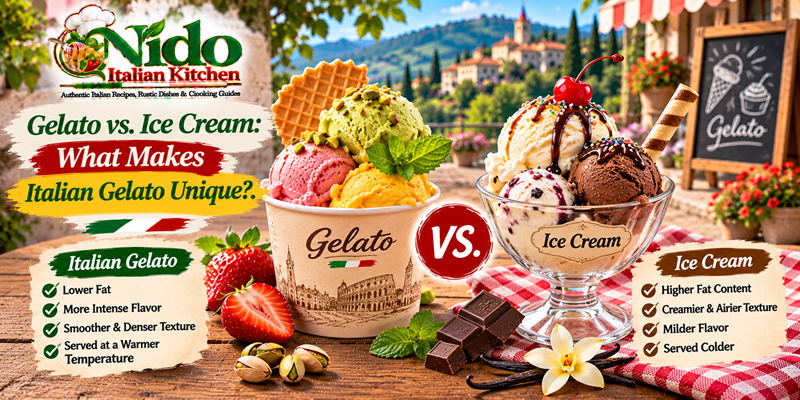
Gelato vs. Ice Cream: What Makes Italian Gelato Unique? In the world of frozen desserts, many consumers assume that Italian gelato is simply another word for standard ice cream. While both confections share basic dairy foundations, their production methods, ingredient ratios, and sensory profiles differ dramatically. Understanding the distinction between gelato vs. ice cream reveals why Italian artisanal gelaterie command global admiration.
Gelato vs. Ice Cream: What Makes Italian Gelato Unique?
True Italian gelato delivers a denser texture, silkier mouthfeel, and far more intense flavor profile than conventional frozen dairy treats. In this educational culinary guide, we will analyze gelato vs. ice cream and explore what makes Italian gelato unique. By examining butterfat content, air incorporation, and serving temperatures, you can appreciate the craftsmanship behind authentic Italian frozen desserts (dolci).
The Historical Roots of Italian Gelato
Understanding the historical evolution of frozen desserts in Italy explains how artisanal gelato developed its distinct culinary identity.
1. Renaissance Culinary Innovation
Although ancient civilizations cooled snow with fruit juices, modern frozen dairy desserts originated in sixteenth-century Italy. Specifically, Florentine architect Bernardo Buontalenti created a creamy frozen confection using milk, cream, egg yolks, and sugar for the Medici court. Shortly after, Sicilian chef Francesco Procopio dei Coltelli introduced gelato to Paris, sparking European fascination with frozen desserts.
2. Artisanal Craftsmanship Tradition
Unlike industrial frozen desserts designed for long-term supermarket storage, traditional Italian gelato evolved as a fresh daily craft. Master gelatieri prepare small batches each morning using seasonal fruits, roasted nuts, and fresh local milk.
Core Differences Between Gelato and Ice Cream
Comparing gelato vs. ice cream highlights three technical factors that transform simple dairy into two completely different desserts. Traditional Cannoli Shells and Sweet Ricotta Filling
1. Butterfat and Dairy Ratios
Standard American ice cream requires at least ten percent butterfat, often reaching up to twenty percent through heavy cream and egg yolks. Conversely, authentic Italian gelato relies primarily on whole milk rather than heavy cream, keeping butterfat levels between four and nine percent. Because fat coats the tongue and dulls taste buds, gelato’s lower fat content allows fruit, nut, and chocolate flavors to taste remarkably vibrant and pure.
2. Churning Speed and Air Incorporation (Overrun)
During freezing, churning machines whip air into the liquid dairy base, a measurement known in the industry as overrun. Commercial ice cream churns rapidly, incorporating up to fifty percent air into the final product. In contrast, Italian gelato churns at a much slower pace, trapping only twenty to thirty percent air. Consequently, gelato feels noticeably denser, richer, and smoother on the palate than fluffy commercial ice cream.
3. Serving Temperature Mechanics
Storage and serving temperatures play a crucial role in how frozen desserts feel inside the mouth. Standard ice cream stays frozen hard at roughly zero degrees Fahrenheit (-18 degrees Celsius) so it remains scoopable without melting. Meanwhile, gelato rests in display cases at slightly warmer temperatures around ten to fifteen degrees Fahrenheit (-12 to -9 degrees Celsius). Serving gelato warmer keeps the texture soft, elastic, and immediately flavorful without numbing the palate.
Key Characteristics of Authentic Artisanal Gelato
-
Natural Color Palette: Genuine pistachio gelato appears muted brownish-green rather than bright neon green, proving it contains real roasted nuts without artificial dyes.
-
Flat Display Trays (Carapine): Traditional gelaterie store gelato inside covered stainless-steel wells or flat pans rather than tall, airy mountains stabilized with vegetable fats.
-
Short Shelf Life: Because artisanal gelato contains minimal preservatives and air, shops serve it fresh within a few days of churning.
-
Spade Serving Method: Gelato servers use a flat metal spatula (spatola) to fold and smear the dense gelato into cups, softening the texture further before serving.
Summary Comparison Matrix: Gelato vs. Ice Cream
| Technical Factor | Traditional Italian Gelato | Standard Commercial Ice Cream |
| Primary Dairy Base | Whole milk with minimal heavy cream | Heavy cream and egg yolk custard |
| Butterfat Content | Low (4% to 9% butterfat) | High (10% to 20% butterfat) |
| Air Content (Overrun) | Low (20% to 30% air) for dense texture | High (40% to 50% air) for light fluffiness |
| Serving Temperature | Warmer (10°F to 15°F / -12°C to -9°C) | Colder (0°F to 5°F / -18°C to -15°C) |
| Serving Utensil | Flat metal spatula (spatola) | Round mechanical ice cream scoop |
Conclusion
Analyzing gelato vs. ice cream clarifies what makes Italian gelato unique in the culinary world. By prioritizing whole milk over heavy cream, churning slowly to reduce air pockets, and serving at warmer temperatures, Italian gelatieri unlock intense, pure flavors. Next time you visit an authentic gelateria, notice how these careful technical choices transform simple ingredients into an unforgettable Italian dessert experience.